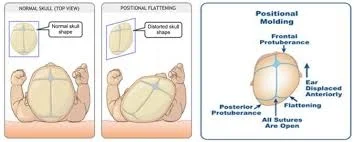
Craniosynostosis is a birth defect in which one or more of the sutures on a baby's head closes earlier than usual.
The skull of an infant or young child is made up of bony plates that allow for growth of the skull. The borders at which these plates intersect are called sutures or suture lines. The sutures between these bony plates normally close by the time the child is 2 or 3 years old. Early closing of a suture causes the baby to have an abnormally shaped head and may limit brain growth.
The cause of craniosynostosis is unknown. Most children with craniosynostosis are otherwise healthy and have normal intelligence.
Symptoms depend on the type of craniosynostosis. They may include:
- No "soft spot" (fontanelle) on the newborn's skull
- A raised hard ridge along the affected sutures
- Unusual head shape
- Slow or no increase in the head size over time as the baby grows
Types of Craniosynostosis
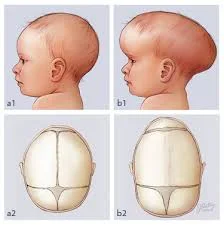
Sagittal synostosis
(scaphocephaly) is the most common type. It affects the main suture on the very top of the head. The early closing forces the head to grow long and narrow, instead of wide. Babies with this type tend to have a broad forehead. It is more common in boys than girls.
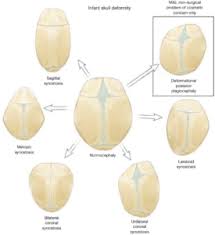
Frontal plagiocephaly
is the next most common type. It affects the suture that runs from ear to ear on the top of the head. It is more common in girls.
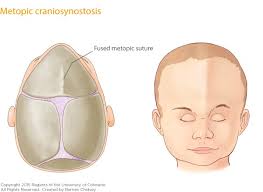
Metopic synostosis
is a rare form that affects the suture close to the forehead. The child's head shape may be described as trigonocephaly. It may range from mild to severe.
Plagiocephaly
Plagiocephaly is a condition where your baby’s head has a flat spot or is misshapen. There are various levels of severity, and can occur during pregnancy or after birth.
Plagiocephaly is a term used to describe an abnormal head shape. The most common cause of plagiocephaly is positioning, and it usually begins in early infancy and peaks around 5 months. This is because babies of this age are usually spending a good amount of time supine as they usually are not yet sitting up.
Since the skull is made up of small islands of bony plates (which allows for brain growth), the skull is quite flexible. The most common treatment involves early detection and repositioning techniques. If a patient has torticollis, which is stiffening of a neck muscle causing a head tilt or turning of the head to one side, then outpatient physical therapy for stretching exercises may be beneficial.
While some patients benefit from helmet therapy for re-molding, not all babies need this treatment. Helmet therapy will most certainly speed up the normalization process, but it is not always necessary. As a pediatric neurosurgery team, our job is to ensure there are no neurosurgical causes for the abnormal head shape and rule out any factors that may prevent helmet therapy from being safe.